This article is my research on Postmodernism. I’ve researched into the cause of this movement, its characteristic and its impact in the art scene. I’m interested in how Postmodernist sees the objective world, the theme in their art and the role of artist in the Post-modern world.
What is Post-modernism?
Technically, it is hard to define what Post-modernism is. Even some of the leading Post-modernist refused to define this “movement”. Art historian E.H. Gombrich refers it as “an altered mood” rather than of a new style. Post-modernist suggest a polytrophic or pluralist world and denied the possibilities of canonization and rationalism. And because this, historian, scholar and art-critic found it hard to give a “proper” definition to this movement. But no matter how, we can still conclude some of the characteristic of this “movement” and its influence through observing the phenomenon.
Through my research, we need to deal with Post-modernism from Epistemology. During pre-modern period, what shape the world are Religious doctrine, faith and metaphysic theories. Right after the pre-modern age, humanism reaching its climax, people raise high rationalism. Knowledge is power. Post-modernism come after modernism after two world wars. In the Post-modernism age, media, technology and information play the major role in shaping the world that we are living in. Walter Truett Anderson (Albert Mohler in Dockery, 2001:56) used an analogy to describe these three periods:
· The Pre-modern perspective suggests that: “There’s ball and there’s strikes, and I call’em the way they are.”
· The Modern perspective suggests that: “I call’em the way I see’em”
· The Post-modern perspective suggests that: “They ain’t nothin’ until I call’em.”
The term Postmodernism was introduced into the discussion in 1975 by Charles Jencks, a young architect who was tired of the doctrine of functionalism. But the seed of this “movement” actually was planted much earlier. Postmodernism was started during somewhere around 1930 after the first World-war. It took about twenty to thirty years of cultivation before it reached the border line of main stream philosophy. During the 60s, it attracted some of the radical artist, writer, philosopher and architect. During the 70s, Postmodernism starts to influence the culture and art from all aspect. It’s only until the 80s, Postmodernism has become a main-stream cultural movement.
Some characteristic of Post-modernism
After my research, I found that characteristics of Postmodernism include:
· De-canonization/ Anti-rationalism/ De-construction
Post-modernist suggest a “rule-less” world and denied the progressive improvement we’ve achieved after Renaissance, the enlightenment period, the industrial revolution, and the modernity.
· Anti-form
Post-modernist denied any art form, they triumphant indeterminacy. Post-modern art are formless, rule-less, often montage and free.
· Depth-less-mess
Against grand/ Meta narrative. Consumerism becomes the leading culture of society. VCD, TV, internet and advertisement in replace of books, music and art, becoming the main-stream mass media. Popular culture blurs the line in between “high-art” and “low-art”.
· Anti-humanism
Post-modernist anti humanism and denied the value of human being. Some artists through self destroy express their thought of art.
Post-modern art scene
I’ve also research into the art scene during the Post-modern age. Some of the significant phenomenons are:
· The way of seeing
If classical artists were showing to the audience the objective world they see, then the Modernist has given the world another new way of seeing. A more direct, self-expressive and emotional approach we can see in their art piece. What they present is not so much the correct representation but they would exaggerate and even change the appearance of things if this suited their aim. Post-modernist denied the viewing experience of tradition. For them, direct instinct is more important than rationality, de-construction is more important than form and structure. They gave up Logos and meta-narrative, chase after impromptu emotion and immediacy.
· Figurative art in Post-modernism
Human are often appeared to be “expression-less”, “spirit-less” or in morbid, Schizophrenia state in Post-modern figurative art. Artists been released after the Sexual revolution. Sex, sex organs, homosexual are some of the main theme of some Post-modern painter. They focused on the “condition of existence” but not “meaning of existence”.
· Post-modern media and technique
Appropriates (take), reproduction (re-make) and collage/assemblage are some of the common technique Post-modern artists use. Like what Dadaist said:“art=anti art; anti-art= neo-art; neo-art=art” and “art is everything, everything is art”, artist assemblage found object and ready make object and turn it into art piece.
· The role of artist, audience and society
In the Post-modern age, the role of artist is closer to art manufacturer or art producer than art-creator. The audience sometimes involves in the creation of art or witness the production. And in the Post-modern consumerism society, art gallery commissions the artist to produce art to fulfill the market needs. Some art creation activities have become mere business activities. Artist creation became a product for consumer to consume.
· Post-modern narration
Instead of the modernist quest for meaning in a chaotic world, the postmodern author eschews, often playfully and cynical, the possibility of meaning and the postmodern novel is often a parody of this quest. This distrust of totalizing mechanisms extends even to the author; thus postmodern writers often celebrate chance over craft and employ meta fiction to undermine the author's "univocal" control (the control of only one voice).
Conclusion
The notion of art has been extended and widened by Post-modern movement. Contemporary writer, musician, artists, illustrators and designers are always looking for alternate possibilities. If the modernist has been fled from narration, preaching and moralizing, the “commercial art” took over the job and been highly used in this pluralist world, through mass media, TV, internet, editorial and all sorts of medias. Contemporary illustration, being influenced by Post-modernism, carries various form and style and various non-traditional narration, giving us “shocking” viewing and aesthetic experiences. Like what E.H. Gombrich have said:” Our knowledge of history is always incomplete. There are always new facts to be discovered which may change our image of the past…” After all, “where is the history heading to” remained the biggest quest of historian, philosopher and artist.
Some sources I got about Post modernity and Postmodernism:
Bibliography:
Wei Zhen, Experience The Spirit of Modernism, China: Guangxi Normal University Press, 2002
A book that talk about the history of art, especially Modern Art from a China scholar and artist point of view, which give me a in-depth understanding about movement before Post modernity.
Ken Ang Lee, A Christian Perspective on Postmodernism, Malaysia:Gospel Culture Centre Bhd, 2005
This book compile systematic and critical analysis writings on how Post modernism has shape the world that we are living today.
E.H. Gombrich, The Story of Art, London: Paidon, 2006
A book that shaping my way of thinking about picture. The last chapter “A story without End” is extremely helpful. Helping me to look at Post modernity from a bird view.
Victoria Lu, The Phenomenon of Art in Postmodern Age, Taiwan: Artist Publication, 1990
This book narrows down the research area to Art. 20 timely essay which were written 20 years ago, giving me an insight view on how Post modernism has impact the art scene.
Hal Foster, The Anti-Aesthetic: Essay on Postmodern Culture, Taiwan: New Century Publishing Co., Ltd., 1998
This book widens and broadens my view about Postmodernism. Compiling articles written by 7 scholars on Consumerism, Postmodernism, Feminism and Post criticism.
The Study of Art, Book 3. Vol. 1 – Video and Trend of Thought in Postmodernism, China: Xue Lin Publishing, 2005
2 articles which I found extremely helpful, What is art?: On the Changes of the Definations of Art by Chen Xiaojuan and Destroying History and Choosing Treachery: An Analysis of Western Postmodern Art.
Internet:
Ihab Hassan, http://www.ihabhassan.com [Accessed on 10 July 08]
The very first scholar who has written/critique on Postmodernism. Relevant essay you can find in the website.
Showing posts with label Writting. Show all posts
Showing posts with label Writting. Show all posts
Friday, July 11, 2008

Monday, June 23, 2008
Cynical realism
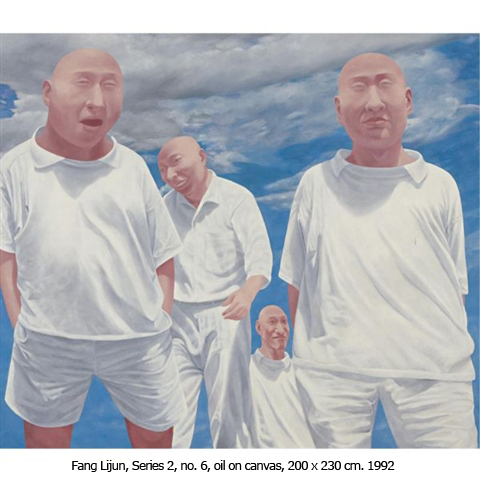
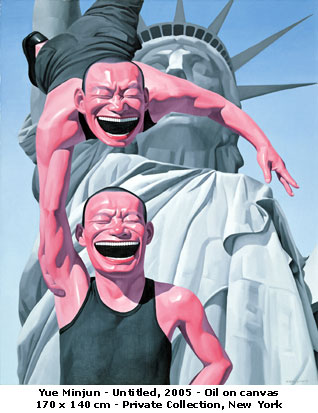
“Cynical realism—it’s the intelligent man’s best excuse for doing nothing in an intolerable situation.” - Aldous Huxley
One thing fascinating about contemporary art from China is like that of a parent watching the struggles of a child as it grows to maturity. By looking at China contemporary art scene, it is also very obvious that China had and maintained academies which emphasized classical skills in oil painting. That these were use to produce socialist realist art, or propaganda posters did not prevent the skills from being transferred down the generations at high level of capability.
Today, few places in Asia remain more mysterious than China. Even in this modern age of globalization where cultural boundaries are being reduced by the march of mass media, China retains its own distinct and complex characteristics as almost no other nation. And this factor influenced the development of art in China. Many of the new collectors are willing to spend tons of money on the high landscapes of Tibet; the colourful clothing of minorities; and the elegant ladies of Shanghai.
But now, through the artist’s skillful hands, we are able to see another side of China. The first generation’s early works showed us the China we knew, and the new generation now offers us a faithful reflection of the changes which have hit China over the last twenty years.
Contemporary artists in Modern China - the individuals – who have to live with the changes of in China, in their paintings project a reflection of “grassroots” pain, uncertainty and cynicism. We can see that these painters are not “court artists” responding to direct patronage of the state or the rich and powerful. Instead, individual artist responds in different ways to the world. In this range of responses, they collectively reflect the confusion of people who have seen the old certainties destroyed, and for whom no new certainties are yet established.
Cynical realism
Cynical realism is a contemporary movement in Chinese art, especially in the form of painting, which began in the 1990s. It is an artistic trend that evolved as an aftermath of the 1989 student demonstrations in Tiananmen and the closing of the “China Avant-Garde” exhibition at the China national Gallery in Beijing. Started in Beijing, it has become the most popular Chinese modernist art movement in mainland China.
It arose through the pursuit of individual expression by Chinese artists that broke away from the collective mindset that existed since the Cultural Revolution. The major themes tend to focus on socio-political issues and events since Revolutionary China (1911) to the present. These include having a, usually humorous, cynical and post-ironic, take on a realist perspective and interpretation of transition that Chinese society has been through, from the advent of Communism to today's industrialization and modernization.
These events which symbolize the climax of the artistic aspirations that built up during the 1980’s collapsed at once and created a void that Fang Lijun, Yue Minjun and others filled with a new message full of irony and indifference to the big forces that the individual is subject to.
Fang Lijun, Yue Minjun were one of the first artists to translate this new social temperament onto the canvas. The idealism of the 1980’s gave room to a more somber and realistic understanding of the role of avant-garde art under a one party regime. Fang Lijun, Yue Minjun and the fellow artists redefined the new artistic tendencies of contemporary Chinese art in the 1990’s. The tragic events which gave birth to Cynical Realism represent a drawback in the Arts community self confidence drive to tackle serious issues in a critical eye.
Fang Lijun’s famous baldhead figure, together with Yue Minjun’s representative smiling character, has already become well known icons in the world of Chinese contemporary art. Fang Lijun's bald man with his ambiguous expression and dreamlike background of unlimited space and freedom became a symbol of the subtle mockery that one can detect in the works of the Cynical Realism artists. Yue Minjuns' art with its humor, cynicism, emphasis of strong vivid colors and the centrality of the individual also displays all the common characteristics of the movement of Cynical Realism.
Leading Artists:
1. Fang Lijun
2. Yue Minjun
3. Zhang Xiaogang
4. Zheng Fanzhi
5. Yang Shaobin
6. Guo Wei
7. Zhao Bo
Links:
http://china-avantgarde.com/index.html
http://wason.library.cornell.edu/Wen/index.php
http://www.artrealization.com/contemporary_chinese_art/movements/cynical_realism.htm
http://www.saatchi-gallery.co.uk/artists/new_art_from-china.htm
http://www.chinesecontemporary.com/
Further Reading:
http://www.amazon.com/Inside-Out-New-Chinese-Art/dp/0520217489
http://www.amazon.com/Mahjong-Contemporary-Chinese-Sigg-Collection/dp/3775716130/ref=pd_sim_b_2
http://www.amazon.com/China-New-Artists-Dian-Tong/dp/0764323245/ref=pd_bxgy_b_img_b
http://www.amazon.com/China-Art-Book-Uta-Grosenick/dp/3832177698/ref=pd_sim_b_4
http://www.amazon.com/New-China-Art-Richard-Vine/dp/3791339427/ref=pd_sim_b_5
Sunday, June 15, 2008
Critical Analysis- Fine Art and Illustration
Abstract
I am a traditionally trained illustrator. My greatest interest is in figurative art. In searching for my future direction, I found that illustration was dismissive and down graded, especially during the early twentieth century in
Keywords: Art, Illustration, Figuration, Painter, Twentieth Century,
Art and Illustration
Arisman started the article with a big question: Is illustration dead? This is one of the pessimistic conclusions voiced by a lot of illustrator today in
I agreed with the saying that editorial illustration is not doing as good as it was during the Golden Age. What was not mention in the article is that this is happening because first, photography has replaced illustration in most editorials; second, painted illustration was once used to decorate and narrate books but now looks out-fashion; the invention of computer make the work of illustrator and designer became blurry[1]; third, this is the age of visual, we watch the monitor or TV screen more than we read a book sometimes.
Arisman disagreed with the pragmatic solutions of art education circles to solve the problem of a shrinking illustration market by encouraging the illustrators to be more flexible in their design skills. He said from his experience, there is only one other career choice for most illustrator and that is figuration in a fine art context whether it is in video, film, painting or sculpture. This claim sounds contradictive because most contemporary use different form to give illustration a newer look. Some combine typography with imagery, some use photo montage, and some combine traditional painting with digital touch up. The job of figurative illustrator is to be creative in ways of narrating, describing and decorating. Illustration students should be given the free-will to choose their area of profession.
History of American Illustration
Later in this article Arisman spent most of the pages offering an overview of the issues of illustration and art from early twentieth century to present day. Thought the chapter was far too short to offer a full history, but he had mentioned some of the key incidents during the early age. First, figurative painting which was once de rigueur for artists during the nineteenth-century was facing a dynamic change. The movement was dismissive of the figure and enamoured of both conceptual and abstract artistic direction. The narrative and descriptive function of figurative painting was questioned by Modernist in
Through the reading of the history, I found that standards that early American art critic used to differentiate fine art and illustrations are as below:
First, it’s subject matter. Fine art has no subject or it’s abstract. Illustration is figurative. And the invention of photography has freed panting from its narrative and descriptive function. Whatever arts or artefact that done for the purpose of narrating or description is claims to be illustration.
Secondly, where does it hang? Those that been hang in the gallery are claimed to be fine art. And those that appear on the print are illustration.
Thirdly, it’s intension. Works that created with the intension to serve the commercial world are claimed to be illustration. Fine art is pure self-exploration.
Fourthly, the job of the artist. Fine art artist should create only “fine” and “pure” art, artist who did cross-over project are claimed as illustrator.
Arisman concluded that the work artist to is in an attempt to clarify or illuminate our relationship to the world and whether we create it abstractly, conceptually, or in a narrative form, define us, our philosophy of life and our aesthetic and intellectual preference. And the business of illustration is the business of making strong, effective, discovering your personal vision as a figurative artist and finding outlets for the work that you produce without falling victim to the false-defined or down-graded ever-changing labels. In his opinion, fine art can be in any form as long as the artist expresses his own opinion and do it for himself. Where else an illustrator is a story-teller, with the ability to write increase his value. All artists illustrate (in hopes of clarifying our views), but not all artist are illustrator. His meaning of “illustrate” here is not only referring to the “painting-action”, but also referring to “conceptual visualisation”. There isn’t any low art or high art; there is only good or bad art. And not every figurative artist is an illustrator.
By examining the standards above, some standards are made too timely and too enamoured of both conceptual and abstract art direction. The subject matter was a main argument. It’s impossible that the subject will be disappearing from art forever. If subject has no longer carried any means, then what is the purpose of seeing? Second, the technology has make art reproduction easier and faster. We see photograph of a fine art piece printed on book, and we also see traditionally painted illustration been hang in the gallery. Third, no doubt most illustration works are created with the intension of selling it out, we cannot deny that when a fine artist create an art piece, he also think about who might buy it from the gallery or auction. Fourth, more and more fine artists doing cross-over job. You will find some artist appear in movie, think Liu Xiao Dong; some do painting and photograph, think David Hockney. The jobs of fine artist become indefinable. Artist nowadays almost do everything.
The debate of illustration as fine art was a big issue in the twentieth-century in
Conclusion
After all, it is still hard to define what contemporary “fine” art is. Today, contemporary artists like Lucian Freud in
Personally I think that despise of blurriness and uncertainty, the main function of the illustrator is to represent, interpret, and heighten the meaning of a selected passage of text (in a complementary way) by means of pictures, with the aim of contributing to the reader’s or viewer’s appreciation of the narrative.
This is a timely writing written to fight with the misunderstanding of fine art and illustration. The author tried to use this article to express his point of view about developing personal vision, especially stress on figurative drawing. He ended his article by saying: ‘It is the challenge and the underlying secret to working at something you love for the rest of your life.’
[1] The reason for this blurriness is because the whole complexion in the design field has change in just the past eight to ten years. Back in the earlier days, designers used to sketch out what they wanted. Then the sketches would be handed to a typesetter, who would do the type size and style; and to an illustrator for illustration work. Then the designer would collect all the components and combine them together for layout for printing. However, computers have changed all of this. Designers nowadays usually combine design, illustration and typesetting into one continuous process which they dot hem all by themselves. With the help of the elaborately changing computer programs and technology, visual communications become handy in the internet world, artist are becoming more and more active, thus illustration becomes trendier, more mature and delicate. As a result of all these, artists become illustrators; illustrators become designers; and maybe the other way around.
(Amatterofdesign™. (2006). It’s A Matter Of Illustration. Victionary.)
[2] Illustration as fine art had its decade of fame. Illustrative imagery was devalued by 1910 and fine-art critics applied the word illustration as an all-encompassing, easy, punitive word for any imagery that featured the figure or realistic elements-a practice that continues through today. (Steven Heller, Marshall Arisman, Inside The Business of Illustration, NY: Allworth Communications, Inc.2004, pg 36)
Arisman also commented that the art critic and curator of Drawing Now: Eight Propositions in year 2002 has again devalued and mislead the audience of the definition of illustration. Arisman stand is that illustration was not flowering from 50s to 70s was because of the Zeitgeist but not as what Ms. Hoptman , the curator said:” Any readable imagery implies lack of complexity; illustration is defined as graphically lively, colourful, entertaining, and commercial. And all these are reasons that have banished illustration from fine art discourse.
Originally posted in http://sioyean.wordpress.com/ by sioyean on May 5th, 2008
Fine Art and Illustration – Searching for a definition
Taiwanese art critic and curator Chien Hui KAO[1] in her book “A Journey to Contemporary Art” questioned about the definition of contemporary art. She used the analogy of chess board game to describe art today. In her opinion, contemporary art is positioned on the boundary river on chess board. Nobody has ever drawn the boundary clearly enough because of its flexibility and always-changing-movement.[2]
It is equally hard to define what contemporary illustration is, and to draw the distinctive difference between illustration, popular art and fine art at this post-modern new age. The reason for this blurriness is because the whole complexion in the design field has change in just the past eight to ten years. Back in the earlier days, designers used to sketch out what they wanted. Then the sketches would be handed to a typesetter, who would do the type size and style; and to an illustrator for illustration work. Then the designer would collect all the components and combine them together for layout for printing. However, computers have changed all of this. Designers nowadays usually combine design, illustration and typesetting into one continuous process which they dot hem all by themselves. With the help of the elaborately changing computer programs and technology, visual communications become handy in the internet world, artist are becoming more and more active, thus illustration becomes trendier, more mature and delicate. As a result of all these, artists become illustrators; illustrators become designers; and maybe the other way around.[3]
When I began formulating my ideas for this article, I was looking for ways to link the identity crisis of contemporary illustrator of Malaysia with the current movement of illustration style in Europe and in the USA. However I thought that it might be pointless to discuss this at the first place if I failed to define the need of identity and style of an illustrator. In Malaysia’s context, illustrators are often been briefed by art director of the style they are looking for. Being given limited freedom and a pre-set style, most illustrators fail to express their own drawing style and with that develop their own visual language. And when this phenomenon has become a common practice in the creative industry, more illustrators has simply become a craftsman.
My goal for this article is to stimulate discussions and not arrive at any conclusion. Is illustration fine art? If there is not much difference between the two, can illustrator create whatever they want to disclose their personal thoughts? Illustrator Benjamin Guedel[4] claimed that ‘only to draw a “nice” picture, for a client that has his own idea is very boring. Under these circumstances it’s only about skills that are brought to the customer. This may turn out good for both sides but such a picture will never become an amazing thing, to draw real good stuff we must have the possibility to give our own view.’[5]
Many art critics and connoisseurs of art claims that the works of illustrators as “minor” arts. This argument is sometime ridiculous. Marshall Arisman[6] said that renting a studio, buying canvas and paint, and painting anything you want does not automatically produce “fine” art. The intent of the artist determines the substance of the work.[7] Like what Otto F. Ege[8] said, no one will challenge Calcar’s draftsmanship by created Versalius Fabrica. The illustrations make a contribution to the total and exact meaning which words alone cannot convey.[9] Why can’t we claim this “illustration” a good example of fine art?
Otto F. Ege said that an artist-painter is more class conscious than an artist-illustrator. What painters concern are the matter of presentation and the audience, while illustrators are concern with mass but not class, reaction. In any illustration the “what” is obviously more important than the “how.” The ability to interpret the text and thereby enrich or increase the perceptibility of the reader is more important than technical skill or the exploitation of current “isms”.[10]
David Smith[11], the sculptor, defined commercial art as “art that meets the minds and needs of other people,’ and fine art as “art that meets the mind and needs of the artist.” Following these definitions, Marshall Arisman comment that many fine artists are “commercial” and some illustrators are “fine”. Andy Warhol said that “the finest art of all is the business of art.[12]
The problem that arises today is that we are in an industry flooded with computer-generated images, photography, the Internet, stock illustration and a lot of ready-made images, and many claims themselves to be artists. In the ocean of design field, sensitivity, intuition and craftsmanship are essential to illustrators and painters alike. I agree with what Steven Heller said the word “illustration” is too limited to be accurate and carries a negative connotation that does not allow it to be viewed as drawing, figurative, or as representational, but rather as commercial, lively entertainment. The phrase “fine art” also needs to be replaced with something that more clearly defines the field and the areas it represent.[13]
[1]Kao, Chien-Hui is a Taiwan art critic and curator who work actively in the USA and Taiwan. Her criticisms are popularly found in Chinese art publication.
[2]Kao, C. H. (2003). A Journey To Contemporary Art. China: BBT Books.pg. 3
[3]AmatterofdesignTM. (2006). It’s A Matter Of Illustration. Victionary.
[4]Benjamin Guedel, a freelance illustrator and comic artist based in Zurich, Switzerland. His bump and grind style is reminiscent of pulp fiction covers and cult film posters of the 1950s with a distinct contemporary, politically incorrect edge. Guedel striking drawings are collected in Blood, Sweat and Tears, a rollicking romp through pop art portraits, pin-ups, pirates and more.
[5]AmatterofdesignTM. (2006). It’s A Matter Of Illustration. Victionary.
[6]Marshall Arisman is an internationally known illustrator and painter. He is the chair of the MFA degree program, “Illustration as Visual Essay” at School of Visual Arts.
[7]Steven Heller and Marshall Arisman. (2004). Inside The Business of Illustration. New York: Allworth Press.pg. 51
[8]Otto F. Ege (1888-1951) was Dean of the Cleveland Institute of Art and Lecturer on the History of the Book at the School of Library Science at Western Reserve University, Cleveland, Ohio.
[9]Ege, O. F. (Autumn, 1949). Illustration as a Fine Art. College Art Journal , 3-11.
http://links.jstor.org/sici?sici=1543-6322%28194923%299%3A1%3C3%3AIAAFA%3E2.0.CO%3B2-D
[10]Ibid.
[11]David Smith was an American Abstract Expressionist sculptor best known for creating large steel abstract geometric sculptures.
[12]Steven Heller and Marshall Arisman. (2000). The Education of an Illustrator. New York: Allworth Press.pg. 3
[13]Steven Heller and Marshall Arisman. (2004). Inside The Business of Illustration. New York: Allworth Press.pg. 49
Originally posted in http://sioyean.wordpress.com/ by sioyean on March 14th, 2008
Artist Statement
Abstract
Water is undeniable an essential element of life. There is a Chinese phrase which says that “water carries the boat and floods the boat.” Water’s intervention in our life is widespread.
Before mirror was invented, reflection of water serve as a “tool” to reflected oneself, both externally and internally. The word “reflection” has different meaning. It can be the illusion of an image produced by mirror or water, and it also means self-examination.
Notion
The notion of this pictorial book is through a series of drawing related to water, reflection and our daily-life, to remind the readers/audiences to reflect the relationship between water and our daily-life.
Introduction of work
My creation is to separate the book into two parts, top and bottom. The top part shows the subject (the real image) and the bottom part shows the reflection. The visual shows a combination of the real subject and the reflection, which form a “dualistic” yet “united” world. Both divided but yet connected one another.
When the surface of water is polluted, the beautiful reflection vanishes. The world been torn apart.
Inspiration
I study the work of both Canadian painter of “magic realism” Rob Gonsalves and Dutch graphic artist M.C. Escher. They have created great optical illusion painting. Japanese photographer Palla’s works also gave me a lot of inspiration.
In one of M.C. Escher’s lecturer, he said:
… I hope that science and art sometimes can touch one another, like two pieces of the jigsaw puzzle which is our human life, and that contact may be made across the borderline between our two respective domains. 1
Execution
One of my concerns is the composition and structure of my image. I am interested to know how image illusion affects our visual perception. I am also interested in creating image symmetrically. Placing symmetrical objects among asymmetrical objects or vise versa create a harmonious composition. When you look at the artwork, you will experience that there are essentially 3 images (1 real image, 1 reflection, 1 overall composition).
In order to get the “right” reflection, I have tried reflecting the image by mirror and flipping it directly in Photoshop to see how the image changes. I also established a grip system on paper and tried to get the reflection by drawing it reverse way.
1 Doris Schattsscheneider, M.C. Escher: Vision of Symmetry,
Saturday, June 14, 2008
Primary and Secondary Research
Primary Research
- Article about Malaysian Illustrator……………Hard to find
- History of Malaysia Illustrator……………No
- Books about Identity of Malaysia illustrator……………No
- Books published by Malaysia Illustrator……………Yes (book store/ publishing/ library)
- Artifact/ Works done by Malaysia Illustrator……………Yes (past newspaper/ poster/exhibition/ supermarket/ packaging)
- Website of Malaysia Illustrator now……………Yes (agency/ publishing/ comic mag)
- Malaysia Illustration Exhibition/ Exhibition catalogs……………Hard to find (only within college circulation)
- Graduation exhibition of local art college……………Yes (need to browse local art college website)
- Local illustration forum……………Yes (pipit/ deviant art/ blog)
- Local events (art related)……………Yes (contact Yuwei/ Comic mag)
Secondary Research
- Article about Identity of Malaysia artist……………Yes (library/ national library/ internet)
- Monthly art magazine (local/oversea)……………Yes (art corridor M’sia(stop)/ art review UK…)
- Contemporary illustration books……………Yes (library/ own collection/ department)
- Website of Contemporary illustration……………Yes (need to sort out)
- Art exhibition (local/oversea) / Catalogs……………Local-Yes/ Oversea-Hard to find (Try Singapore)
- History of world illustration……………Yes (Library)
- History of world art movement……………Yes (Library)
Research topic breakdown
Identity and visual language of contemporary Malaysia illustrator
[identity] who are we?
[visual language] shared memory of Malaysian. theme, colour, events, pictures, memory,
[contemporary] 1986 - 2008 digital age, history.
[Malaysia] nationality, geographical identity
[illustrator] illustrator or fine art artist? types of illustrator, nature of the profession.
originally posted in http://sioyean.wordpress.com/ by sioyean on February 3rd, 2008
[identity] who are we?
[visual language] shared memory of Malaysian. theme, colour, events, pictures, memory,
[contemporary] 1986 - 2008 digital age, history.
[Malaysia] nationality, geographical identity
[illustrator] illustrator or fine art artist? types of illustrator, nature of the profession.
originally posted in http://sioyean.wordpress.com/ by sioyean on February 3rd, 2008
Identity and visual language of contemporary Malaysia illustrator
After rounds of battle within, I have finalise my research direction. I finally came to the conclusion that in order to continue my journey as an artist, the foremost important agenda is to know my identity.
Historically, Malaysia is a new country and “Malaysia” was a new invented word. A common question being asked among Malaysian is that how “Malaysia” we are? Or what is “Malaysia-ness”? Art has been regarded as being able to become a channel of reality representation, and even an instrument of identity construction. Of course, when speaking about representation, we cannot deny the rise of another question, which or whose Malaysia that the artist represent?
The rapid growth of globalisation has shape the look of Malaysian artist. What can we use to represent Malaysia? Is there anything we can regard as “Malaysia Style”? In the field of commercial illustration, is there a need to create a style? I am excited to dig it out!
originally posted in http://sioyean.wordpress.com/ by sioyean on January 30th, 2008
Historically, Malaysia is a new country and “Malaysia” was a new invented word. A common question being asked among Malaysian is that how “Malaysia” we are? Or what is “Malaysia-ness”? Art has been regarded as being able to become a channel of reality representation, and even an instrument of identity construction. Of course, when speaking about representation, we cannot deny the rise of another question, which or whose Malaysia that the artist represent?
The rapid growth of globalisation has shape the look of Malaysian artist. What can we use to represent Malaysia? Is there anything we can regard as “Malaysia Style”? In the field of commercial illustration, is there a need to create a style? I am excited to dig it out!
originally posted in http://sioyean.wordpress.com/ by sioyean on January 30th, 2008
Subscribe to:
Posts (Atom)
